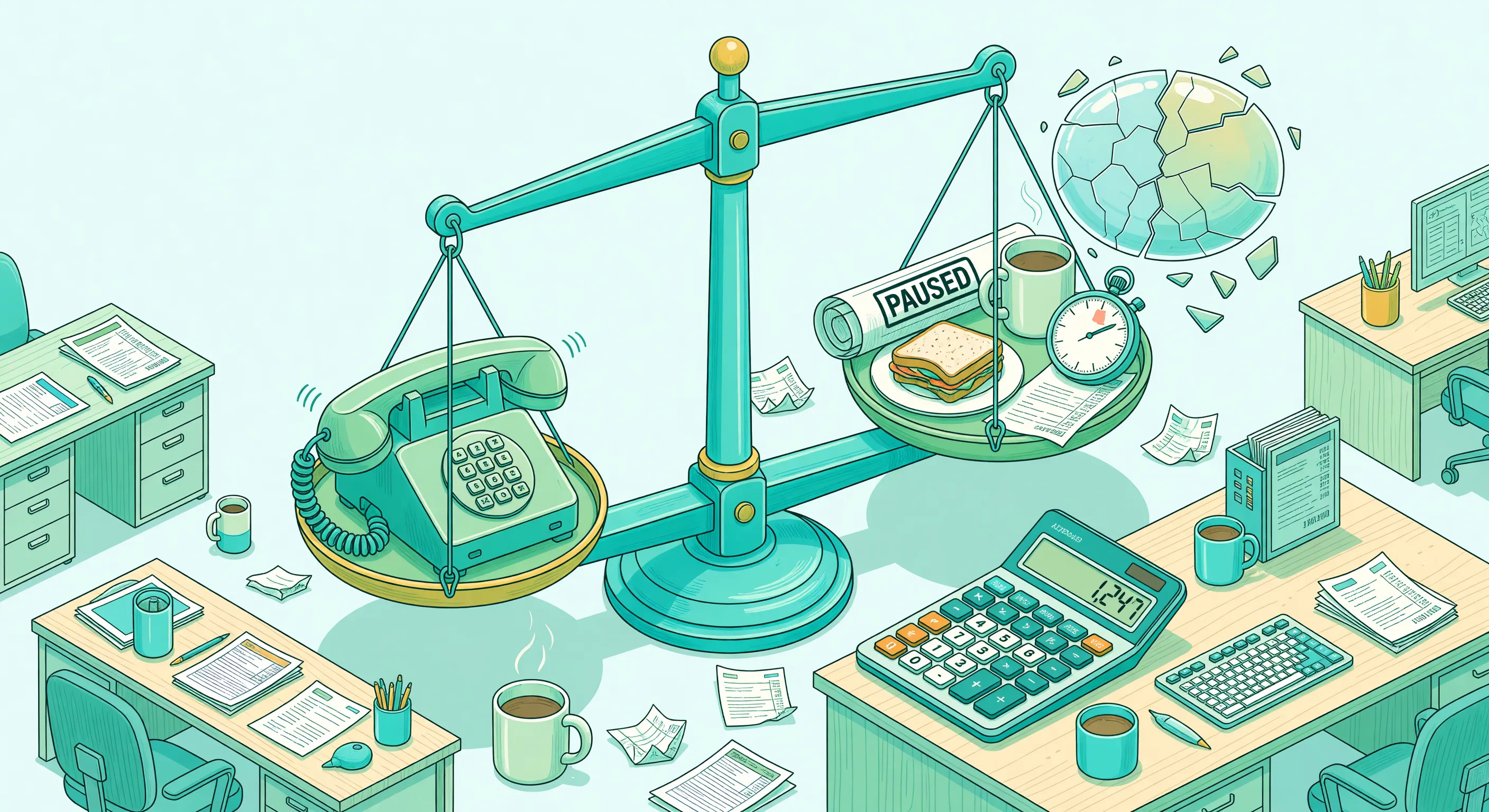

You answer the phone. It’s a 4-minute call. Someone asking about your services, your availability, your pricing. You give them the information, hang up, and go back to what you were doing.
Except you don’t really go back. Not right away. Your brain needs time to reload the context of whatever you were working on before the phone rang. That proposal you were writing. That design you were tweaking. That spreadsheet you were reconciling. It takes, on average, 23 minutes and 15 seconds to fully refocus after an interruption.
That number comes from a widely cited study by Dr. Gloria Mark at UC Irvine, and it has been replicated across multiple research settings. The finding is consistent: even brief interruptions carry a disproportionately large cognitive cost.
So that 4-minute phone call? It actually cost you 27 minutes. And if your phone rings 8-12 times per day (normal for a small business), you’re losing 3.5 to 5.5 hours of productive work time. Every single day.
The Interruption Tax
Researchers call it “attention residue.” After you switch tasks, part of your brain is still processing the previous activity. You’re thinking about what the caller said, whether you should follow up, if you quoted the right price. Meanwhile, you’re trying to write a proposal that requires your full concentration.
The result is that both tasks suffer. You give the caller a mediocre experience because you were distracted when they called, and you produce lower-quality work after hanging up because your brain is split.
A 2023 study published in the Journal of Experimental Psychology found that knowledge workers who are frequently interrupted make 20% more errors and take 27% longer to complete tasks compared to those who work in uninterrupted blocks.
For a business owner, errors and delays translate directly into money.
Calculating Your Actual Cost
Let’s do the math with a realistic scenario. Suppose you’re a freelance consultant, architect, or small business owner who bills at 80 euros per hour. That’s not unusual in the DACH region or most US metros.
Your daily phone interruption cost:
- Average calls per day: 10
- Average call duration: 4 minutes
- Recovery time per call: 23 minutes
- Total time lost per call: 27 minutes
- Total time lost per day: 270 minutes (4.5 hours)
- Your hourly rate: €80
- Daily cost of phone interruptions: €360
That’s €360 per day. Over a 22-working-day month, that’s €7,920 per month in productivity lost to phone interruptions. Per year: roughly €95,000.
Even if you cut these numbers in half (assuming some calls are quick and some don’t fully derail your focus), you’re still looking at €47,000 per year in lost productive capacity.
Now compare that to the cost of not answering the phone yourself:
| Solution | Monthly Cost | Notes |
|---|---|---|
| Answering the phone yourself | €3,960 - €7,920 in lost productivity | Based on €80/hr rate, 5-10 calls/day |
| Hiring a part-time receptionist | €1,500 - €2,500 | Plus benefits, training, sick days |
| Traditional answering service | €200 - €500 | Scripts, limited hours, per-call fees |
| AI phone assistant (Safina) | €9.99 - €59.99 | 24/7, no per-call fees within plan |
The numbers speak for themselves. Use our phone cost calculator to run the calculation with your own hourly rate and call volume.
The Deep Work Problem
Cal Newport popularized the term “deep work” in his 2016 book: cognitively demanding tasks that require sustained, uninterrupted focus. Writing code, preparing legal briefs, designing buildings, strategizing for a client. This is the work that moves your business forward and that you get paid the most for.
Deep work requires blocks of 60-90 minutes without interruption. Every phone call resets that clock. If your phone rings every 30-45 minutes (which is common during business hours), you never enter a deep work state at all. You spend your entire day in shallow mode: answering calls, replying to emails, handling small tasks. The high-value work gets pushed to evenings and weekends, which leads to the next problem.
The Stress and Health Cost
It’s not just about money. Constant interruptions raise cortisol levels. A study from the University of California found that workers in open offices (with frequent interruptions) had cortisol levels 35% higher than those who could work without disruption.
Elevated cortisol leads to:
- Difficulty sleeping, even when you’re exhausted
- Increased irritability and shorter temper
- Reduced ability to make complex decisions
- Higher blood pressure over time
Many business owners describe a low-level anxiety that never fully goes away: the feeling that the phone might ring at any moment, that they can’t fully disconnect, that there’s always something waiting. That’s your nervous system running on alert mode, and it takes a toll that doesn’t show up on a balance sheet.
Three Approaches Compared
Option 1: Keep Answering Everything Yourself
The real cost: €47,000 - €95,000/year in lost productivity (at €80/hr), plus stress, plus the quality reduction in your actual work.
When it makes sense: If you receive fewer than 3 calls per day and they’re all from high-value clients who specifically want to speak with you.
The trap: Most business owners think they’ll “just handle a few calls.” But call volume grows with the business, and the habit of always being available becomes hard to break. You end up as the bottleneck.
Option 2: Hire a Receptionist or Assistant
The cost: €18,000 - €35,000/year for part-time, €35,000 - €55,000/year for full-time (Germany), or $30,000 - $45,000/year (US). Plus employer costs, training, holidays, and sick leave.
When it makes sense: If you have 20+ calls per day and many of them require human judgment, scheduling in real time, or relationship management with key clients.
The downside: Coverage gaps. A single employee doesn’t work evenings, weekends, or holidays. They get sick. They take vacation. And there’s a ramp-up period of 2-4 weeks before they know your business well enough to handle calls confidently.
Option 3: Use an AI Phone Assistant
The cost: €9.99 - €59.99/month with Safina, depending on call volume. Basic (30 minutes) covers most solo professionals. Pro (100 minutes) handles busier small businesses. Business (250 minutes) works for teams.
When it makes sense: For 80-90% of small businesses and solo professionals. Most inbound calls follow predictable patterns: “What are your hours?” “Can I book an appointment?” “What do you charge?” “I need to leave a message.” An AI assistant handles these consistently, 24/7, without costing you €80/hour in lost focus.
What you get: Every call answered. A summary sent to your phone with caller info, reason for calling, and any action items. No interruption to your work. No rings during client meetings. No missed calls at 7 PM.
For a detailed comparison of how different approaches affect your response time, check our response time calculator.
The Shift in Thinking
Most business owners resist delegating the phone because they believe they need to personally handle every caller. “Nobody knows my business like I do.” “Clients want to talk to the owner.” “I don’t want to seem unavailable.”
These concerns are valid for maybe 10-15% of calls: the complex situations, the high-value relationships, the sensitive conversations. For those, you should pick up the phone yourself.
But the other 85%? The “what are your hours” calls? The “can you email me a quote” calls? The “I’m calling to schedule” calls? Those don’t need you. They need someone (or something) that picks up, gets the information, and passes it along so you can respond on your own terms.
The business owners who grow past a certain point are the ones who figure this out. They protect their time for the work that only they can do, and they set up systems for everything else.
What To Do Next
Start by tracking your interruptions for one week. Keep a simple tally: every time the phone rings, note the time, the duration, and whether the call required your personal involvement or could have been handled by an assistant. Most people are surprised by the results.
Then run the numbers. The phone cost calculator will show you exactly what your current phone situation costs versus the alternatives. And if you want to try letting someone else handle the calls, Safina offers automatic call answering that takes about 5 minutes to set up. Your phone still rings first. If you don’t pick up, Safina does.
Your time is your most expensive resource. Spending it on calls that don’t need you is the most common, and most fixable, productivity leak in small business.