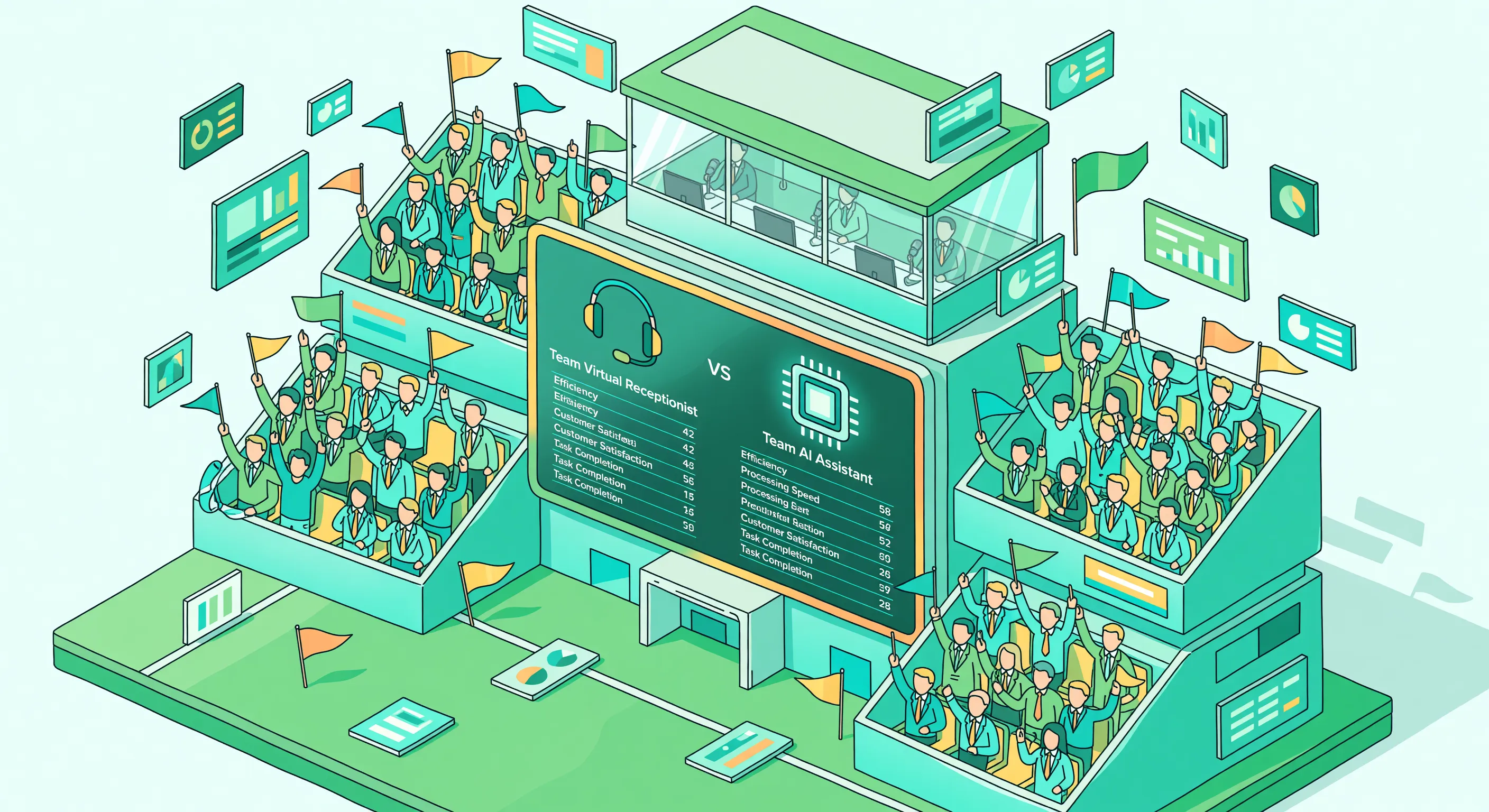

Two Solutions, Very Different Approaches
If you’ve started looking into ways to handle your business calls when you can’t answer, you’ve probably come across two categories: virtual receptionists and AI phone assistants. Both answer your calls. Both take messages. Both claim to solve the missed-call problem.
But they work in fundamentally different ways, cost very different amounts, and fit different types of businesses. This post breaks down exactly how they compare so you can pick the right one.
What Is a Virtual Receptionist?
A virtual receptionist is a real human being who works for an answering service company. When you can’t answer your phone, calls forward to their team. A live person picks up, greets the caller with your business name, and handles the call according to a script you’ve set up.
Popular virtual receptionist services include Ruby, Smith.ai, AnswerConnect, and Abby Connect. In Europe, companies like ebuero and Bueroservice24 offer similar services.
How it works:
- You set up call forwarding from your phone to the service’s number
- A receptionist at the service’s call center answers
- They follow your script: greet the caller, ask questions, take messages
- You receive the message via email, text, or an app
The receptionist is typically handling calls for multiple businesses, switching between clients throughout their shift. They may or may not be familiar with your specific industry.
What Is an AI Phone Assistant?
An AI phone assistant uses conversational AI to answer calls. There’s no human on the other end. The AI speaks with a natural-sounding voice, listens to the caller, responds in real time, collects information, and sends you a structured summary.
Services in this category include Safina, Goodcall, and several newer entrants. The AI is trained to handle phone conversations specifically, which is a different challenge from chatbots or text-based AI.
How it works:
- You set up call forwarding (same as a virtual receptionist)
- The AI answers with your business greeting
- It has a natural back-and-forth conversation with the caller
- You receive a summary with the caller’s name, number, reason for calling, and other details
No human is involved in the call itself. The AI handles the entire conversation autonomously.
The Comparison
Cost
This is where the difference is most dramatic.
Virtual receptionists typically charge between $200 and $500 per month for basic plans, which usually include 50-100 receptionist minutes. Overage charges run $1.50-$2.50 per minute. A busy small business that uses 150 minutes per month could easily spend $400-$700.
Some premium services like Ruby charge even more. Their starter plans begin around $245/month for 50 minutes.
AI phone assistants are significantly cheaper. Safina’s plans start at $11.99/month for 30 minutes (Basic), $29.99/month for 100 minutes ( Pro), and $69.99/month for 250 minutes (Business). Additional minutes cost $0.23 each.
| Virtual Receptionist | AI Phone Assistant (Safina) | |
|---|---|---|
| 30 minutes/month | $200-300/month | $11.99/month |
| 100 minutes/month | $300-500/month | $29.99/month |
| 250 minutes/month | $500-800/month | $69.99/month |
For a solo professional or small business, the AI option is roughly 10-20x cheaper for the same call volume.
Availability
Virtual receptionists are limited by human staffing. Most services operate during business hours with some offering extended hours or 24/7 coverage (at a premium). After-hours calls often go to a different team or a less personalized service.
AI phone assistants are available 24/7/365 with no change in quality. The AI doesn’t have shifts, sick days, or lunch breaks. A call at 3 AM gets the same experience as a call at 10 AM.
For businesses that receive calls outside standard hours (healthcare, property management, trades, hospitality), 24/7 availability without premium charges is a significant advantage.
Languages
Virtual receptionists typically offer English and sometimes Spanish. Bilingual receptionists are available from some services, but multilingual support (3+ languages) is rare and expensive. Finding a receptionist who speaks German, French, or Mandarin requires a specialized service.
AI phone assistants can handle multiple languages natively. Safina supports 30+ languages, switching based on the caller’s language. For businesses in multicultural areas or those serving international clients, this is a major differentiator.
Call Quality
This is the category where virtual receptionists have historically held the advantage. A human can:
- Pick up on emotional cues that AI might miss
- Handle unusual or complex situations with flexibility
- Build rapport with repeat callers
However, the gap is narrowing. Modern AI phone assistants handle natural conversation well, including pauses, interruptions, and follow-up questions. They’re also consistent: the AI doesn’t have a bad day, doesn’t rush through calls at the end of a long shift, and doesn’t put callers on hold while looking up your script.
Where virtual receptionists still win is in high-stakes conversations (complex scheduling, sensitive intake calls) and in situations that require real-time judgment calls the AI hasn’t been trained for.
Setup and Customization
Virtual receptionists require an onboarding process: you provide scripts, FAQs, and instructions. Changes to your script may take a day or two to implement. Some services are flexible; others have rigid templates.
AI phone assistants are typically set up in minutes. You configure your greeting, business information, and call handling preferences through an app or dashboard. Changes take effect immediately.
Scalability
Virtual receptionists scale linearly with cost. More calls mean more receptionist minutes, which means a bigger bill. During unexpected call spikes (a positive news mention, a seasonal rush), you may hit your minute cap and face overage charges.
AI phone assistants handle call volume surges without breaking a sweat. The AI can manage multiple simultaneous calls (something no single receptionist can do). You still pay per minute, but the per-minute cost is much lower and there are no capacity constraints.
When to Choose a Virtual Receptionist
A human virtual receptionist makes sense when:
- Your calls require complex judgment. If callers often need on-the-spot decisions, detailed scheduling, or nuanced triage that goes beyond information collection, a human is better equipped.
- Personal connection is critical to your business. Some industries (luxury services, high-end consulting, concierge medicine) depend on callers feeling they’re getting white-glove treatment. A skilled human receptionist delivers that.
- You have the budget. If $300-700/month for call handling fits comfortably in your operating costs, a virtual receptionist gives you human warmth and flexibility.
- Your call volume is very low. If you only get 10-15 calls a month that need answering, the cost difference between a virtual receptionist and AI is less meaningful.
For a deeper comparison of answering services, see our AI phone assistant vs answering service analysis.
When to Choose an AI Phone Assistant
An AI phone assistant is the better fit when:
- Cost matters. For solo professionals, freelancers, and small businesses, $11.99-$69.99/month vs $200-800/month is a meaningful difference. That’s money you can spend on marketing, equipment, or hiring.
- You need 24/7 coverage. If your business receives calls at all hours (medical practices, property managers, trades), the AI provides consistent coverage without overtime charges.
- You need multilingual support. If your callers speak multiple languages, an AI assistant that handles 30+ languages out of the box is far more practical than hiring multilingual receptionists.
- You want instant setup. No onboarding calls, no script workshops, no waiting period. Set up today, start answering calls today.
- Your calls follow a pattern. If 80% of your calls involve the same thing (appointment inquiries, price quotes, general information), an AI handles them efficiently and consistently.
Can You Use Both?
Yes. Some businesses use an AI phone assistant as their primary backup for missed calls and a virtual receptionist for specific situations (complex intake calls, VIP clients, or calls that require real-time scheduling in a legacy system).
This hybrid approach gives you 24/7 coverage at a low base cost while keeping a human available for the calls that genuinely need one.
The Bottom Line
Virtual receptionists and AI phone assistants solve the same problem (your phone rings and you can’t answer it), but they solve it at very different price points and with different strengths.
If budget is a factor, if you need multilingual support, or if you want 24/7 coverage without premium pricing, an AI assistant is the practical choice. Safina starts at $11.99/month and takes about 5 minutes to set up.
If personal touch matters more than cost, and your call volume is low enough that the per-minute premium is manageable, a virtual receptionist gives you something AI can’t yet fully replace: a real human on the line.
For most small businesses, the AI route gets you 90% of the benefit at 10% of the cost. And that math is hard to argue with.