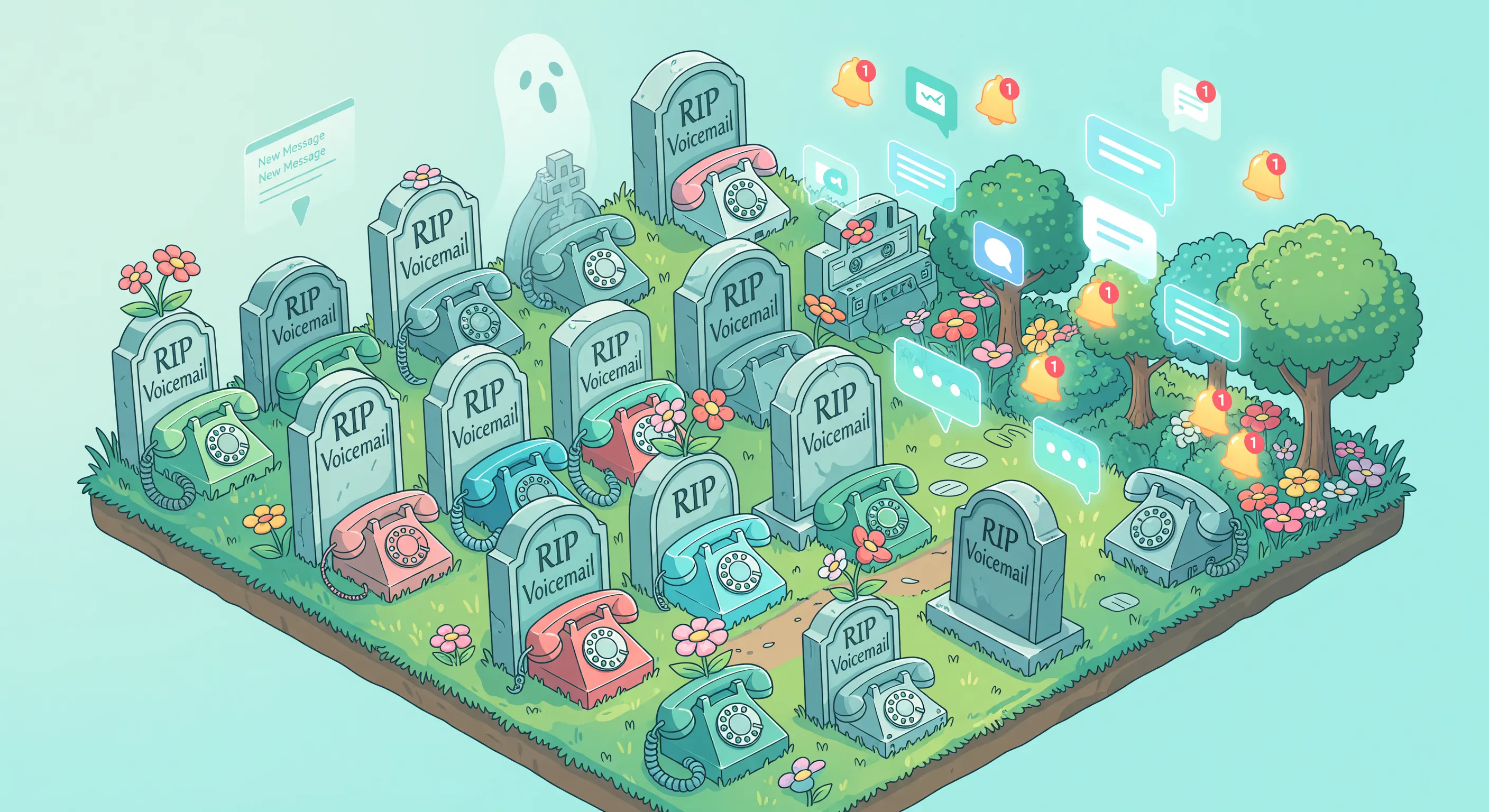

Your Voicemail Is Not Catching What You Think
Most small business owners assume their voicemail works as a backup. If they miss a call, the voicemail picks up, the caller leaves a message, and they call back later. Problem solved.
Except that is not what happens. Not even close.
A 2023 study by Hiya, covering billions of phone interactions, found that 80% of callers who reach voicemail hang up without leaving a message. They hear the beep, and they’re gone.
That number hasn’t changed much over the years. If anything, it has gotten worse. Voicemail was designed in the 1980s for a world where people had no other options. Today, callers have dozens of alternatives, and most of them prefer those alternatives to talking at a machine.
The Numbers Are Worse Than You Think
Let’s look at the full picture.
80% of callers hang up at voicemail (Hiya, 2023). Out of every 10 people who hear your greeting, 8 leave nothing. No name. No number. No message. Just a missed call notification on your phone.
Only 33% of voicemails are ever listened to (YouMail industry data). Even the messages that do get recorded sit unheard. People check their voicemail less often than they check their physical mail, and that is saying something.
Average time to check voicemail: 48+ hours (multiple industry sources). By the time you listen to a Monday morning voicemail, it may be Wednesday. The caller needed a plumber, a dentist appointment, or a price quote. They got it from someone else on Monday afternoon.
67% of callers who reach voicemail say they don’t trust it will be checked (Vonage consumer research). The caller has no way of knowing if you will hear their message in 10 minutes or 10 days. That uncertainty drives them to try another business instead.
Put these numbers together and the story is clear. Your voicemail box is not a safety net. It is a hole in the floor.
Why Callers Hate Voicemail
The statistics paint the picture, but the reasons behind them matter just as much. Here is what callers say when asked why they don’t leave voicemails.
It Feels Like Talking to a Wall
A voicemail is a one-way conversation with no feedback. You don’t know if you’re speaking too fast, if the recording is cutting out, or if you’re providing the right information. There is no acknowledgment that you’ve been heard. You just talk into silence and hope for the best.
Compare that to any modern communication: text messages show delivery receipts. Emails confirm they were sent. Chat apps show read indicators. Voicemail gives you nothing.
No Confirmation It Was Received
After leaving a voicemail, the caller has zero confirmation that it reached anyone. Did the business check their voicemail today? This week? Ever? There is no read receipt, no “We got your message” auto-reply, nothing.
This ambiguity is frustrating enough for personal calls. For a business inquiry where money is on the line, it is a dealbreaker.
No Idea When You’ll Hear Back
“Please leave a message and we’ll get back to you as soon as possible.” Every business says this. Few define what “as soon as possible” means. Is that 10 minutes? 4 hours? Tomorrow?
Callers who need a service provider today cannot afford to wait an undefined amount of time. So they don’t. They call the next name on the list.
Younger Callers Have Already Moved On
Caller demographics have shifted. People under 35 grew up with text messages, chat apps, and social media. A 2024 report from Zendesk found that 60% of consumers under 40 will abandon a business interaction after a single bad experience, and reaching a voicemail counts as one.
For many younger callers, voicemail feels like fax machines: technically functional, but nobody wants to use them.
The Business Impact You Don’t See
Here is the hidden cost of relying on voicemail. You think you have a backup system. You think you’re catching missed calls. But your voicemail is letting 80% of callers slip away silently.
You never see these people in your missed call log (well, you see a missed call, but no information about who called or what they wanted). You never get their voicemail because they didn’t leave one. You have no idea how many potential clients are calling, getting your voicemail, and hiring your competitor instead.
The numbers add up fast. If you get 10 calls per day and miss 4 of them, and 80% of those callers don’t leave a voicemail, that is 3.2 callers per day you know nothing about. Over a month, that is roughly 70 unknown missed contacts. If even 30% of those were potential clients with an average job value of €400, you’re looking at €8,400 per month in revenue that disappeared without a trace.
Want to see the math for your business? Our missed call cost calculator runs the numbers based on your call volume and industry.
What Actually Works in 2026
Voicemail isn’t going anywhere. It is still built into every phone. But treating it as your primary backup for missed calls is a mistake. Here are the alternatives, from simplest to most effective.
1. Record a Better Voicemail Greeting
If you are going to have voicemail (and you will, as a fallback), at least make the greeting work harder. A good greeting:
- States your business name
- Acknowledges you missed the call
- Gives a specific callback timeframe (“within 2 hours during business hours”)
- Offers an alternative contact method (text, email, website form)
A bad greeting: the default carrier message, a greeting recorded years ago, or dead silence followed by a beep.
Our voicemail script generator creates professional greetings in seconds. It won’t fix the 80% hangup rate, but it may improve the experience for the 20% who do leave a message.
2. Enable Visual Voicemail
Visual voicemail shows your voicemails as a list with transcriptions, so you can read them instead of dialing in and listening. Most smartphones support it. It doesn’t change caller behavior (people still won’t leave messages), but it means you can scan and respond to the messages that do come in much faster.
On iPhone, visual voicemail is built in. On Android, it depends on your carrier and phone model, but most major carriers support it.
3. Set Up Call-Back Notifications
Some virtual phone systems and apps can send you a notification the moment a call is missed, even if no voicemail is left. This at least gives you the caller’s number so you can call back quickly.
Speed matters here. Research from Harvard Business Review shows that responding within 5 minutes makes you 100 times more likely to reach the caller than waiting 30 minutes. A missed-call notification with quick callback is better than a voicemail that sits for 48 hours.
4. Forward Calls Instead of Letting Them Go to Voicemail
The most effective change is to stop sending callers to voicemail at all. Forward unanswered calls to a number where someone (or something) answers.
You can forward to:
- A business partner or colleague
- A virtual receptionist service
- An AI phone assistant
Call forwarding takes a few minutes to set up. Our call forwarding guide covers every phone and carrier.
5. Use an AI Phone Assistant
This is what closes the gap. An AI phone assistant answers the call, has a natural conversation with the caller, collects their name, number, and reason for calling, and sends you a structured summary. The caller gets a real interaction, not a beep and silence. And you get all the information you need to follow up.
Safina does exactly this. When your phone goes unanswered, Safina picks up, greets the caller with your business name, and handles the conversation. You receive a push notification with all the details.
The difference from voicemail is dramatic:
| Voicemail | AI Phone Assistant | |
|---|---|---|
| Caller experience | Talk to a machine, hope someone listens | Have a real conversation, know your message got through |
| Information captured | Whatever the caller decides to say (if anything) | Structured data: name, number, reason, urgency |
| Response time | 48+ hours average | Instant notification, callback within minutes |
| Caller completion rate | 20% leave a message | 90%+ have a conversation |
| Cost | Free (included with phone plan) | From €9.99/month |
For a solo professional or small business, the math is straightforward. If voicemail costs you even one client per month (and it almost certainly costs you more), the €9.99 Safina Basic plan pays for itself many times over.
Voicemail Had a Good Run
Voicemail served its purpose for 40 years. It was better than nothing. But caller expectations have changed, caller behavior has changed, and the data shows that voicemail as a business tool is broken.
80% of callers won’t use it. 67% don’t trust it. And the average business takes two days to check it.
You don’t need to get rid of voicemail. Keep it as a last resort. But stop treating it as your plan A for missed calls. Forward those calls to something that actually answers, actually collects the information, and actually tells you about it right away.
Your callers will appreciate it. Your revenue will, too.