
Missing a phone call can mean losing a client. Whether you run a law practice, a plumbing business, or a freelance design studio, every unanswered ring is a potential deal that walks away. So you need something (or someone) to pick up when you can’t.
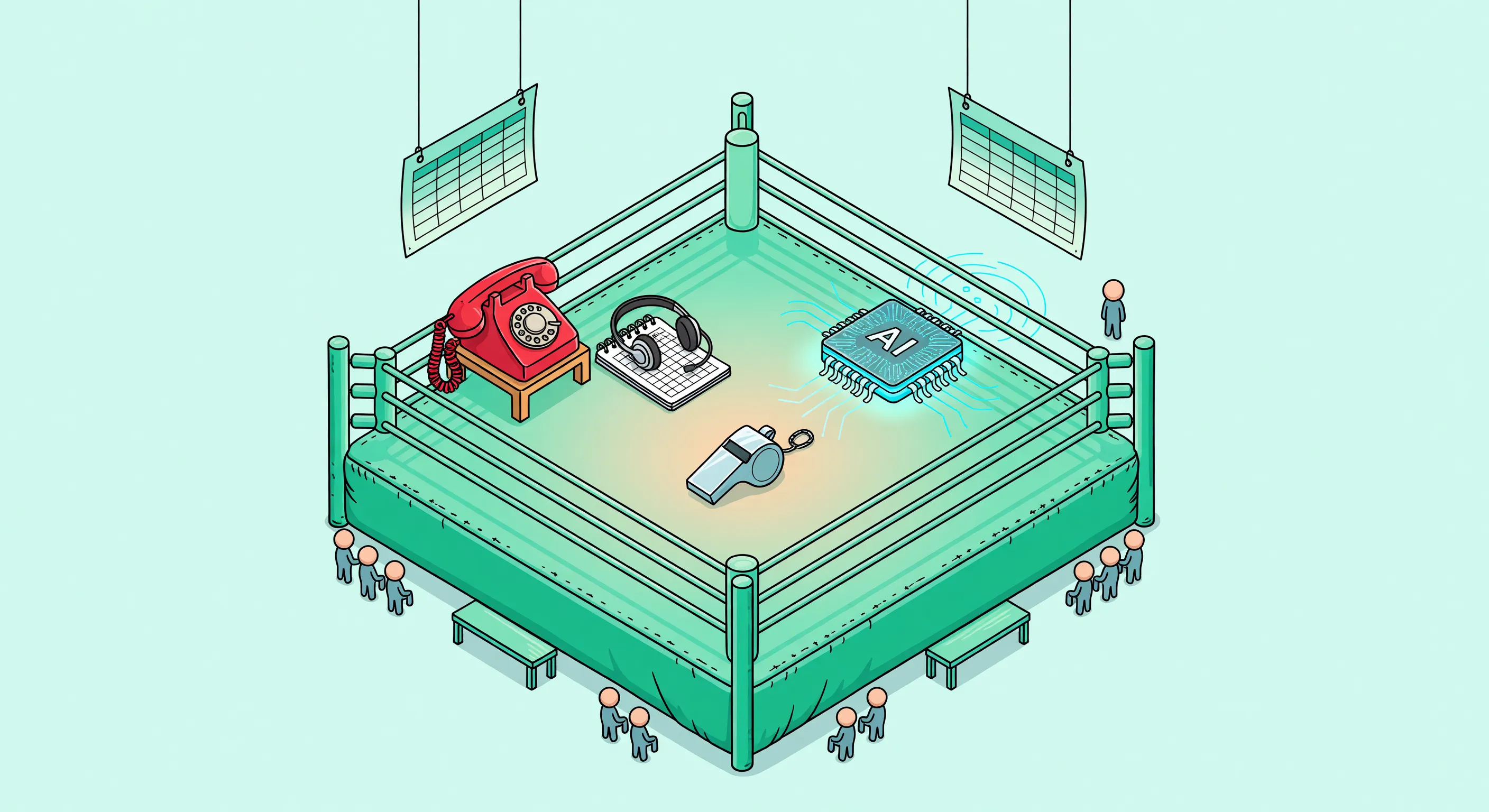
Two options dominate the market right now: AI phone assistants and traditional answering services (sometimes called virtual receptionists or, in Germany, Bueroservice). Both solve the same core problem, but they work very differently under the hood.
This guide breaks down the real differences so you can choose the right fit.
What Is an AI Phone Assistant?
An AI phone assistant is software that answers incoming calls on your behalf. It greets callers, asks relevant questions, records the conversation, and sends you a summary with key details. There is no human on the other end. Modern AI assistants like Safina use voice synthesis that sounds natural and can handle structured conversations (booking requests, contact details, service inquiries) without a script reader.
Setup takes minutes, not weeks. You download an app, configure a few settings, activate call forwarding from your existing number, and you are live.
What Is a Traditional Answering Service?
An answering service employs real people who pick up your phone under your business name. Operators work from a call center, follow scripts you provide, and relay messages by email, SMS, or fax. Companies like ebuero, Bueroservice24, and Starbuero have offered this model for decades.
The human touch is the main selling point. A trained receptionist can pick up on tone, handle emotional callers, and improvise when a conversation goes off-script.
Head-to-Head Comparison
Here is how the two approaches stack up across the dimensions that matter most:
| Dimension | AI Phone Assistant | Traditional Answering Service |
|---|---|---|
| Monthly cost | From €9.99/mo (e.g., Safina Basic) | €100 - €300/mo + per-call or per-minute fees |
| Availability | True 24/7/365, no surcharges | Business hours standard; after-hours coverage costs extra and is often limited |
| Setup time | 5 minutes (app download, configure, activate forwarding) | Days to weeks (onboarding, script creation, test calls) |
| Personalization | Template-based greeting, learns your business context over time | Human operators following customized scripts |
| Languages | 50+ languages, automatic detection | Usually 1-2 languages; additional languages at higher cost |
| Call quality | Consistent every time, but less emotional range | Human warmth, empathy, ability to improvise |
| Scalability | Unlimited concurrent calls | Limited by the number of available operators; hold times during peak hours |
| Integrations | CRM, webhooks, push notifications, structured data export | Typically email or fax summaries; some offer basic CRM plugins |
Let’s dig into the details.
Cost
This is where the gap is widest. AI phone assistants operate at a fraction of the cost because there are no salaries, no office space, no shift scheduling. Safina’s Basic plan costs €9.99 per month for 30 minutes of call time. The Pro plan (€24.99/mo, 100 minutes) covers most small businesses. Even the Business tier at €59.99 per month for 250 minutes is a fraction of what answering services charge.
Traditional answering services typically start around €100 per month, and that often includes only a limited number of calls. Per-call surcharges of €1 to €2 are common, plus per-minute fees on top. A busy month can easily push the bill past €300 or €400.
Use our phone cost calculator to estimate what you would actually spend with either approach based on your call volume.
Availability
AI assistants do not sleep, take breaks, or celebrate holidays. Your AI assistant answers the phone at 2 AM on Christmas Eve with the same quality as at 10 AM on a Tuesday. No overtime surcharges, no reduced weekend coverage.
Answering services operate during business hours by default. Many offer after-hours packages, but these cost more and often come with reduced staff. On public holidays, coverage may not be available at all.
For businesses that receive urgent calls outside office hours (medical practices, property management, emergency services), true 24/7 coverage without surcharges is a significant advantage.
Setup and Onboarding
Getting started with an AI phone assistant is fast. With Safina, you pick your industry template, enter your business name, and activate call forwarding. Five minutes from download to live.
Answering services require onboarding meetings, script development, test calls, and sometimes training sessions. Expect days to weeks before everything runs smoothly. If your scripts need updating (new services, seasonal changes, staff turnover), each change requires coordination.
Personalization and Call Handling
Here is where answering services still have an edge. A trained human can read between the lines. If a caller sounds distressed, an operator can adjust their tone, slow down, or offer reassurance. Scripts are guidelines, not constraints, and a good receptionist knows when to go off-script.
AI assistants follow structured conversation flows. They are excellent at collecting specific information (name, phone number, reason for calling, preferred appointment time) and do so consistently every single time. But they are not going to pick up on a caller’s frustration the way a human would.
That said, AI assistants are improving rapidly. Callers often do not realize they are speaking to an AI, and most do not mind as long as their request is handled properly.
Languages
If your business serves an international clientele, AI has a clear advantage. Safina supports 50+ languages with automatic language detection. A caller can start in Spanish, and the assistant responds in Spanish. No additional cost, no special setup.
Answering services are typically limited to one or two languages (often German and English in the DACH region). Additional languages require specialized staff, which means higher costs and limited availability.
Scalability
During a marketing campaign, a product launch, or a seasonal peak, call volume can spike. An AI assistant handles this without breaking a sweat: ten simultaneous calls, fifty, a hundred. There is no queue, no hold music, no “all operators are currently busy.”
Answering services are constrained by headcount. During high-volume periods, callers may wait on hold or get sent to voicemail, which defeats the purpose of having someone answer.
Integrations
AI phone assistants are built for the digital workflow. Safina delivers push notifications to your phone, provides structured call summaries, and can connect to CRMs and other tools via webhooks. The data from every call is captured in a format you can actually work with.
Traditional answering services typically send you an email or SMS after each call. Some offer basic integrations with CRMs, but the data is usually free-form text rather than structured fields.
Who Should Choose an AI Phone Assistant?
An AI phone assistant is the better choice if you:
- Are cost-conscious. The price difference is substantial, especially at higher call volumes.
- Need true 24/7 coverage. No surcharges, no gaps, no holidays off.
- Operate in multiple languages. Automatic detection across 50+ languages.
- Want fast setup. Live in minutes, not weeks.
- Handle mostly structured calls. Appointment requests, contact info collection, service inquiries.
- Value data and integrations. Structured summaries, CRM connections, webhooks.
If this sounds like your situation, see how Safina compares to specific answering services or check out automatic call answering for your industry.
Who Should Choose a Traditional Answering Service?
A traditional answering service makes more sense if you:
- Handle sensitive or emotional calls. Therapy practices, crisis hotlines, bereavement services.
- Need complex call handling. Detailed consultations, multi-step troubleshooting, or calls that frequently go off-script.
- Want a human voice at all costs. Some businesses (luxury brands, concierge services) consider a real human operator part of their brand identity.
- Have highly variable call scripts that change daily and require operator judgment.
For a detailed look at one popular answering service, read our Safina vs. ebuero comparison.
The Hybrid Approach
You do not have to choose just one. Some businesses use an AI assistant for routine calls (the majority) and keep a human answering service for specific situations. For example:
- AI for after-hours and weekends, human service during peak business hours
- AI for standard inquiries, human operators for VIP clients
- AI as the first line, escalating to a human when the call requires it
This gives you the cost savings and availability of AI for 80-90% of calls, while keeping the human touch where it counts.
The Bottom Line
For most small businesses and solo professionals, an AI phone assistant delivers better value. The cost savings alone are significant: you could run Safina’s Pro plan for an entire year for less than one month of a typical answering service. Add 24/7 availability, instant setup, multilingual support, and structured data capture, and the case is strong.
But answering services are not obsolete. For calls that demand empathy, nuance, or complex problem-solving, a real person is still the better choice. The good news is that these situations are the minority for most businesses.
Start by honestly assessing your call patterns. How many calls do you get? When do they come in? What do callers typically need? The answers will point you in the right direction.