
“I’ll Get Back to You” — A Phrase That Makes Customers Uneasy
As a heating installer, you’re an in-demand expert. Your days are filled with maintenance, emergencies, and complex installations. When the phone rings in the middle of all that, it’s often hard to say more than a quick “I’m busy right now, I’ll call you back later.” But that exact phrase can create a lot of uncertainty for a potential new customer or an existing one with an urgent problem.
Professional customer communication is just as important today as the quality of your craftsmanship. It determines whether a prospect becomes a customer and whether an existing customer stays loyal. Especially on the phone — the first point of contact — the course is set for a successful customer relationship.
Common Communication Pitfalls in Daily Work
In the hectic daily life of an installer, there are several typical pitfalls that can leave an unprofessional impression, even if that’s not your intention:
- Missing information: You’re on a noisy job site and only catch half of what’s said. Important details like the exact address or the customer’s problem get lost.
- No clear expectations: After the call, the customer doesn’t know when to expect a callback — today, tomorrow, or not until next week?
- Lack of consistency: Sometimes you answer personally, sometimes voicemail picks up, sometimes an employee answers. The caller experience is different every time and comes across as disorganized.
These small oversights add up and can make customers feel they’re not in good hands, even when your work is top-notch.
How a Clear Structure Improves Your Communication
The solution lies in a system that ensures every caller — no matter when or why they call — has a consistent and professional experience. You don’t have to answer every call personally, but you need to make sure every call is handled professionally.
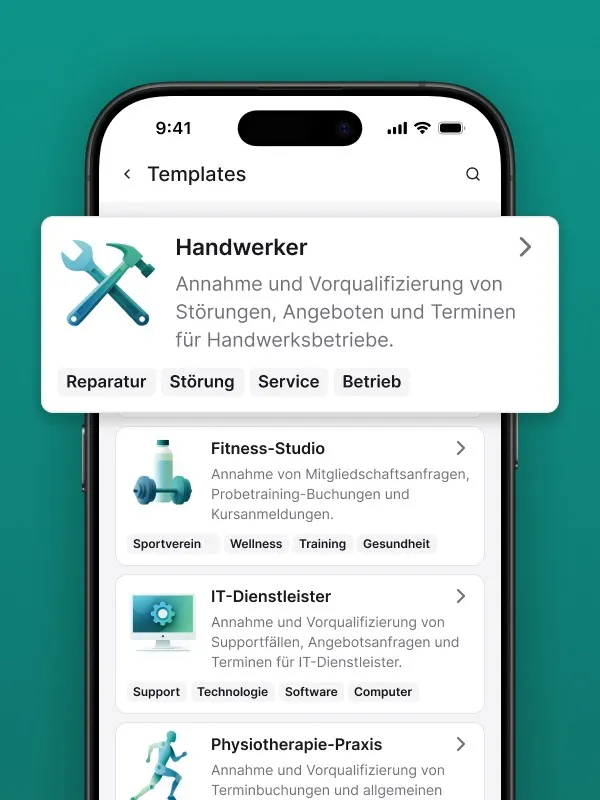
This is where a digital assistant can help you bring clear structure to your phone communications. Instead of leaving calls unanswered, an AI-powered phone assistant like Safina, for example, takes the call for you and handles it according to your specifications. The assistant can:
- Collect essential information: It ensures that the customer’s name, phone number, and reason for calling are always captured completely and accurately.
- Pre-qualify the inquiry: Is it a broken heating system in winter (high urgency) or a request for routine maintenance in three months (low urgency)?
- Set clear expectations: The assistant can give the caller a reliable timeframe for your callback (e.g., “Mr. Schmidt will get back to you within two hours.”).
You receive all the information neatly prepared on your phone. During a quiet moment, you can return the call fully prepared, with all the facts at hand, and leave a highly professional impression from start to finish. You’re not just optimizing your communication — you’re also boosting the efficiency of your entire operation.