
Why Language Matters on the Phone
When someone calls your business, they expect to be understood. Not in a vague, “I kind of get what you’re saying” way, but properly understood. If a caller speaks French and your receptionist only speaks English, that call is effectively lost. The caller may try a few words in broken English, get frustrated, and hang up.
For businesses serving international clients or operating in multilingual areas (Switzerland, border regions, tourist-heavy cities), language coverage on the phone is not a nice feature. It directly affects whether calls convert to customers.
How Automatic Language Detection Works
Safina does not use phone menus. There is no “Press 1 for English, press 2 for French” menu tree. Instead, the process is straightforward.
The caller says something. Safina’s speech recognition analyzes the first few seconds of audio and identifies the language. From that point on, Safina responds in the detected language. The entire detection happens within the first sentence, so there is no noticeable delay.
This works because modern speech recognition models process language identification as part of the transcription pipeline. Safina does not need to ask, it listens and knows.
For businesses, this means every caller is served in their preferred language without any manual setup per language. You configure Safina once with your business information, and it handles the rest regardless of which language walks through the (virtual) door.
Mid-Call Language Switching
Real conversations are not always monolingual. A German business owner might start a call in German, realize the caller is more comfortable in English, and switch. With a human receptionist, this requires the person to actually speak both languages. With Safina, it happens automatically.
Here is a practical example. A tourist calls a dental practice in Munich:
Caller: “Hallo, ich brauche einen Zahnarzttermin…” Safina: “Gerne! Wann wäre Ihnen ein Termin am liebsten?” Caller: “Actually, sorry, is it okay if we continue in English? My German isn’t great.” Safina: “Of course! When would you prefer to schedule your appointment?”
The switch is instant. No restart, no awkward pause, no need to call back and reach a different department. The conversation flows naturally across the language boundary.
This matters especially for industries like healthcare, real estate, and consulting where callers come from diverse backgrounds and may not be fluent in the local language.
Language Quality Tiers
Not all languages perform at the same level. Here is an honest breakdown.
Top Tier (Best Quality)
German, English, Spanish, French. These languages have the most training data, the most refined speech models, and the most natural-sounding voice synthesis. Callers speaking these languages get the closest-to-human experience. Accent handling is also strongest in this tier, so regional dialects and non-native speakers are well understood.
Strong Performance
Italian, Portuguese, Dutch, Polish, Swedish, Danish, Norwegian, Turkish, Russian, Japanese, Mandarin Chinese, Korean. These languages work well for business conversations. Speech recognition is accurate, and responses sound natural. There may be occasional moments where phrasing is slightly less idiomatic than in top-tier languages, but callers generally do not notice.
Supported (Good, With Occasional Variation)
Arabic, Hindi, Thai, Vietnamese, Czech, Hungarian, Finnish, Greek, Romanian, Ukrainian, and many more. Safina supports these languages and handles them well for standard business conversations. Voice quality and recognition accuracy are good, though the range of accents and dialects handled may be narrower than in higher tiers.
The full list includes over 50 languages. If your business serves a specific language community, contact us to ask about quality in that particular language.
Single-Language vs. Multilingual Configuration
You have two options when setting up Safina for language handling.
Multilingual mode (recommended for most businesses): Safina detects the caller’s language and responds accordingly. Your greeting, questions, and information are configured once, and Safina translates the conversation flow into the detected language. This is the default and works well for businesses that receive calls in multiple languages.
Single-language mode: Safina always responds in one specific language, regardless of what the caller speaks. This is useful for businesses with a very specific audience where language consistency matters (for example, a German-language-only service line).
Most businesses benefit from multilingual mode. It catches every caller in their preferred language and costs nothing extra, it is included in every plan.
The Business Impact of Multilingual Support
Consider this scenario. You run a property management company in Zurich. Your tenants speak German, French, Italian, and English. Without multilingual phone support, you need either four separate phone lines, a multilingual receptionist (expensive and hard to find), or you accept that some callers cannot communicate their maintenance requests effectively.
With Safina, a French-speaking tenant calls about a broken heater. Safina greets them, has the conversation in French, captures the problem details, and delivers you a summary in your preferred language. The tenant feels heard, and you get a clear action item.
Multiply that across dozens of tenants and multiple languages, and the value becomes clear. No language menu, no “please call back during our French hours,” no lost requests due to miscommunication.
For businesses in Switzerland, Germany’s border regions, or any industry serving international clients, multilingual phone support is table stakes. With Safina, you get it starting at $11.99/month without hiring a single additional person.
Practical Tips for Multilingual Setup
If you serve callers in multiple languages, here are some tips for getting the best results.
Keep your greeting language-neutral or in your primary language. Safina will switch to the caller’s language after detecting it. Starting with a short greeting in your main language is fine because Safina switches within the first exchange.
Test in your key languages. Call your own number from a friend’s phone and have conversations in each language your callers commonly use. Review the summaries to confirm the quality meets your expectations.
Use your script templates as a starting point. Our templates are designed to work across languages, with questions that translate well and produce clear, structured call summaries.
Check your call summaries. Safina can deliver summaries in the caller’s language or in your preferred language. If you prefer all summaries in English regardless of the call language, you can configure that in settings.
App Language vs. AI Language
Safina has two independent language settings. Understanding the difference avoids confusion.
App language controls the menus, buttons, and text you see in the Safina app. It has no effect on what your callers hear. You can use the app in English while your AI assistant greets customers in German.
To change the app language:
- Go to the “Profile” tab in the bottom menu bar.
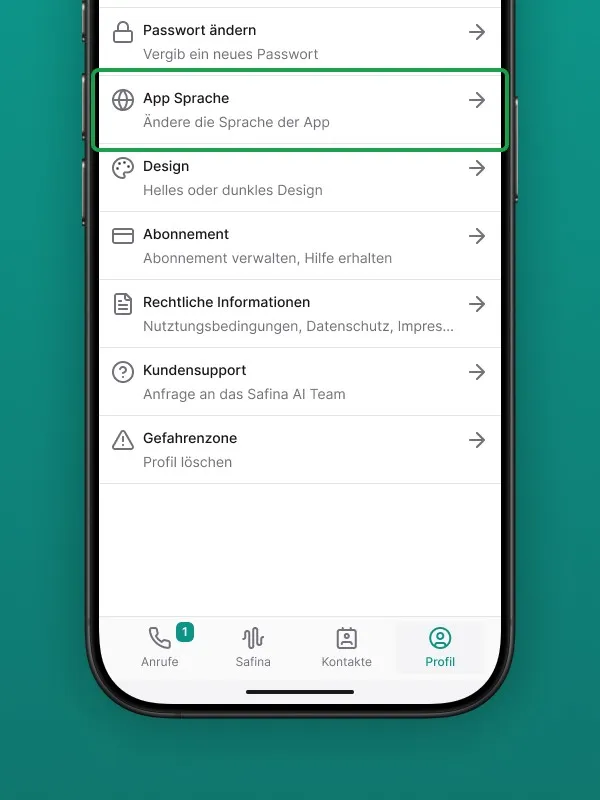
- Select “App Language”.
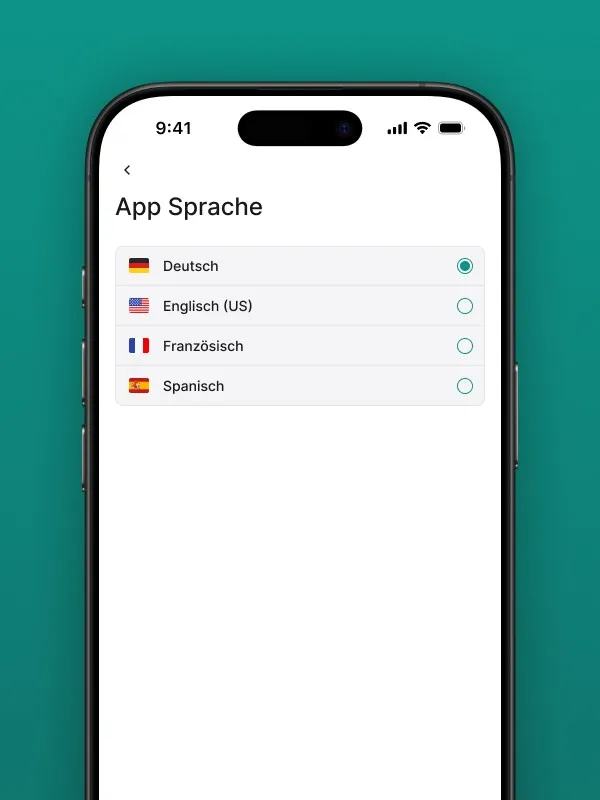
- Choose your preferred language. The app switches immediately.
AI language controls what your callers hear. This is where you set the primary language Safina uses to greet callers and have conversations.
To change the AI language:
- Go to the “Safina AI” tab.
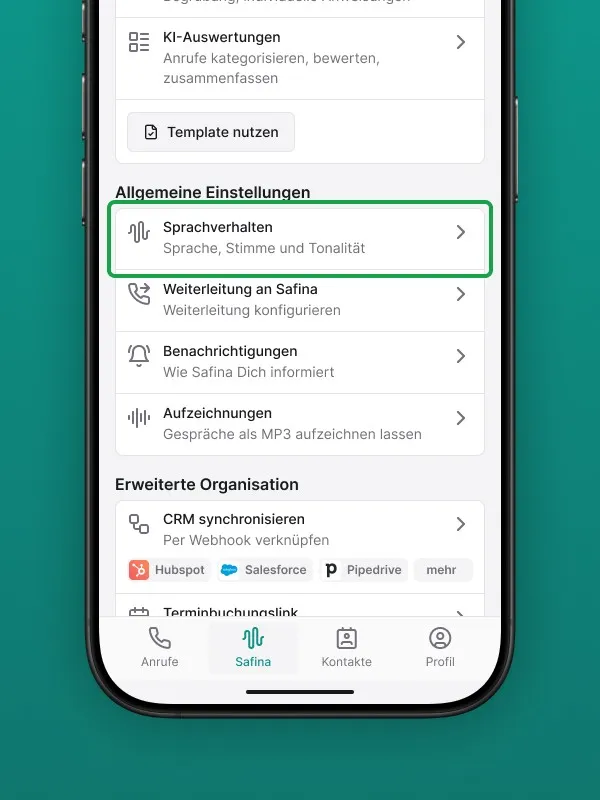
- Scroll to the “Speaking Behavior” section.
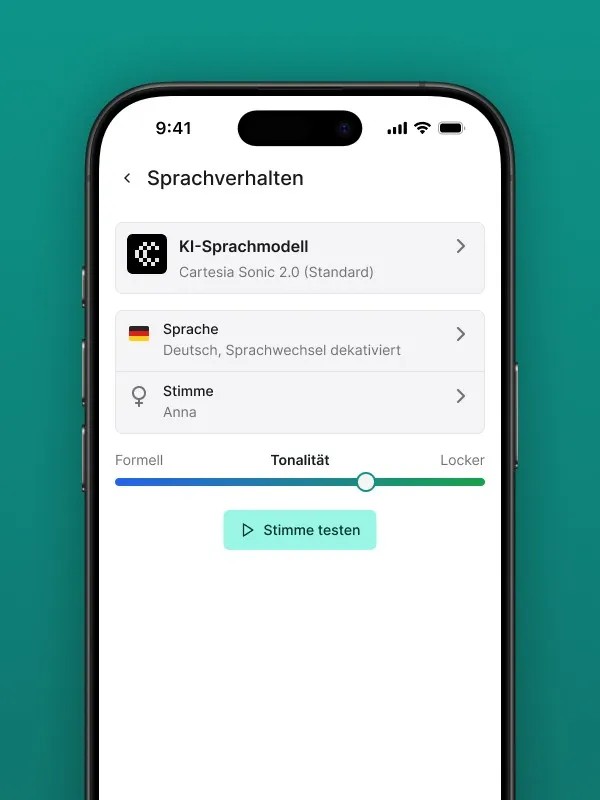
- Here you can set:
- Language: The primary language Safina uses to greet callers. During a conversation, Safina can also detect other languages and switch automatically.
- Voice: Pick from the available voices.
- Tone: Decide whether your assistant should address callers formally or casually.
Quick summary: Want to change the app menus? Go to Profile. Want to change what callers hear? Go to Safina AI.
For a complete walkthrough of setting up Safina, visit our getting started guide. To see how other businesses in your industry handle multilingual calls, browse our industry pages.